An accessible, practical and ultimately inspiring book that not only serves as a much-needed call to arms to end the plastic pandemic, but gives useful tools on how to make meaningful change in our everyday lives and advice on how to demand long-lasting action.
Enough plastic is thrown away every year to circle the world 4 times
More than 8 million tonnes of plastic enter the oceans each year
300 million tonnes of new plastic is produced every year
An estimated 15-51 trillion pieces of plastic now litter the world's oceans
38.5 million plastic bottles are used every day in the UK
A million plastic bottles are used per minute around the world
500 million plastic straws are used per year
Without big action, at the current rate, pieces of plastic will outnumber fish in the ocean by 2050. That is the legacy we are leaving our children and grandchildren.
Plastic flows into our lives from every direction and most of it is not recycled. Instead, it is incinerated or ends up in landfill, where it will sit for hundreds of years, or enters the world's seas where it fragments into tiny pieces to become microplastics - the environmental scourge of our times.
Many of us had assumed that governments, brands and waste authorities were dealing with plastic on our behalf. But the impact of shows such as Blue Planet along with national beach cleans and high-profile campaigns have resulted in a collective wake-up call. If there were plans and strategies, they have not worked as we imagined. It would be easy to feel despondent but instead we need to turn our anger and emotion into action, starting by making a big dent in our own enormous consumption.
Turning the tide on Plastic is here just in time. Journalist, broadcaster and eco-lifestyle expert Lucy Siegle provides a powerful call to arms to end the plastic pandemic along with the tools we need to make decisive change. It is a clear-eyed, authoritative and accessible guide to help us to take decisive and effective personal action.
Because this matters. When it comes to single-use plastics, we are habitual users, reaching out for plastic water bottles, disposable coffee cups, plastic straws and carrier bags multiple times a day. If only 12 of us adopt Lucy's 'reduce, rethink, refill, refuse' approach, we could potentially ditch 3K-15K single items of plastic in a year. When we consider our power as influencers - whether at school, the hairdressers, at work or on the bus - we suddenly become part of something significant.
So now is the time to speak up, take action and demand the change you want to see in the ocean, in the supermarket aisles and on the streets. It's time to turn the tide on plastic, and this book will show you how.
Long ago and far away, in a land that time forgot, Before the days of Dylan, or the dawn of Camelot. There lived a race of innocents, and they were you and me, For Menzies was in the Parliament in that land where we were born, Where navels were for oranges, and Peyton Place was porn. We longed for love and romance and waited for our Prince, Eddie Fisher married Liz, and no one's seen him since.
We danced to 'Little Darlin,' and sang to 'Stagger Lee' And cried for Buddy Holly in the Land That Made Me, Me. Only girls wore earrings then, and 3 was one too many, And only boys wore flat-top cuts, except for Jean McKinney.And only in our wildest dreams did we expect to see A boy named George with Lipstick, in the Land That Made Me,Me.
We fell for Frankie Avalon, Annette was oh, so nice, And when they made a movie, they never made it twice. We didn't have a Star Trek Five, or Psycho Two and Three, Or Rocky-Rambo Twenty in the Land That Made Me, Me.
Miss Kitty had a heart of gold, and Chester had a limp, And Tarzan was a loner whose co-star was a chimp.
We had a Mr. Wizard, but not a Mr. T, And Oprah couldn't talk yet, in the Land That Made Me, Me. We had our share of heroes, we never thought they'd go, At least not Bobby Darin, or Marilyn Monroe.
For youth was still eternal, and life was yet to be, And Elvis was forever in the Land That Made Me, Me.
We'd never seen the rock band that was Grateful to be Dead, And Aeroplanes weren't named Jefferson, and Zeppelins were not Led.
And Beatles lived in gardens then, and Monkees lived in trees, Madonna was Mary in the Land That Made Me, Me. We'd never heard of microwaves, or telephones in cars, And babies might be bottle-fed, but they were not grown in jars. And pumping iron got wrinkles out, and 'gay' meant fancy-free, And dorms were never co-Ed in the Land That Made Me, Me. We hadn't seen enough of jets to talk about the lag, And microchips were what was left at the bottom of the bag. And hardware was a box of nails, and bytes came from a flea, And rocket ships were fiction in the Land That Made Me, Me. T-Birds came with portholes, and side shows came with freaks, And bathing suits came big enough to cover both your cheeks. And Coke came just in bottles, and skirts below the knee, And Castro came to power near the Land That Made Me, Me. We had no Crest with Fluoride, we had no Hill Street Blues, We had no patterned pantyhose or Lipton herbal tea Or prime-time ads for those dysfunctions in the Land That Made Me, Me. There were no golden arches, no Perrier to chill, And fish were not called Wanda, and cats were not called Bill. And middle-aged was 35 and old was forty-three, And ancients were our parents in the Land That Made Me, Me. But all things have a season, or so we've heard them say, And now instead of Maybelline we swear by Retin-A. They send us invitations to join AARP, We've come a long way, baby, from the Land That Made Me, Me.
So now we face a brave new world in slightly larger jeans, And wonder why they're using smaller print in magazines. And we tell our children's children of the way it used to be, Long ago and far away in the Land That Made Me, Me.
Those who didn't grow up in the fifties have missed the greatest time in history,
FRENCH aerospace company Airbus SE that makes the world's largest passenger aircraft – the A380 that's flown by numerous international airlines to Australia – is building five huge new airfreighters that will move outsize aircraft parts as large as fuselage sections, and entire wings and tails from makers world-wide, to Toulouse in France and Hamburg in Germany, where Airbus has assembly centres that put its new planes together.
And so big will these monster new Airbus BelugaXL freighters be that they will be able to carry up to fifty-three tons of aircraft parts at a time from supplier plants in several European countries, the UK and even China and the USA, to those assembly centres.
Each of the new Belugas, the first of which will go into service in 2019, will be capable of flying some 30 per cent more cargo than Airbus's existing airfreighters, and do so in single hops of up to 4,000 kilometres.
Named Beluga because of the resemblance of their nose sections to the head of the Arctic's white Beluga whales, Airbus has had a bit of fun in going even further in giving its new airfreighters painted-on "eyes" and a grinning "mouth," as it admits the voluminous raw aeroplanes will not be the most beautiful in the sky.
[] EVEN their makers say the voluminous new Airbus Beluga XL airfreighters in their raw form will not be the most beautiful aeroplanes in the sky when they start flying next year. Note how tiny the cockpit appears in the nose.(Airbus SE)
[] BUT given a bit of a paint job with "eyes" and a grinning "mouth," they will take on a whole new personality, as this artist's impression shows. (Airbus SE)
** Development of next-generation hybrid super sports car underway**
** Drivetrain technology shared with Le Mans-winning TS050 Hybrid race car**
Toyota has confirmed it has started development of a road-going super sports car that uses the same hybrid drivetrain technology as that honed in its Le Mans-winning Toyota GAZOO Racing TS050 Hybrid race car.
The announcement coincided with the Japanese carmaker's historic first ever win in the iconic 24 hours of Le Mans World Endurance Championship race in France.
Shigeki Tomoyama, President of GAZOO Racing Company, said that competing in the World Endurance Championship - one of the most demanding motorsports series - and racing at Le Mans had helped Toyota advance the development of its hybrid technology.
"We started this project because we believe that creating a super sports car that delivers the same appeal as the TS050 Hybrid greatly adds to Toyota's involvement in WEC. And at some point in the near future, customers will have a chance to get behind the wheel of this incredible machine and experience its astonishing power and driving performance," said Tomoyama.
To further whet fans' appetites, Toyota displayed the GR Super Sport Concept at the Toyota GAZOO Racing "Fan Village" during the Le Mans race.
The GR Super Sport Concept was unveiled at the Tokyo Auto Salon in January and features the same 735kW (1000hp) twin-turbo V6 Toyota Hybrid System - Racing (THS-R) drivetrain as the TS050 race car.
Beneath the sleek white bodywork, the GR Super Sport Concept shares many of its components with the TS050 race car reflecting Toyota GAZOO Racing's aim to ensure that technologies and know-how acquired in motorsport are fed back into new production vehicles.
KARL LAGERFELD and MODELCO are pleased to announce the global launch of their limited-edition colour cosmetics collection today. To celebrate, KARL LAGERFELD and ModelCo will take over Paris.
100 KARL LAGERFELD + MODELCO "Beauty Butlers" will make their mark in Paris throughout the day. They will all be dressed in custom-designed helmets that are a 3D cartoon reinterpretation of Karl Lagerfeld. This design is also a key element in the collection and appears on the LIP LIGHTS Lip Gloss, the collection's hero product.
The "Beauty Butlers" will visit iconic locations in Paris including the Eiffel Tower, Les Tuileries, Champs-Elysées, Saint-Germain-des-Près, Montparnasse and Palais de Tokyo —inviting members of the public to join them for a special performance at each stop along the way. The Beauty Butlers' finale will be at 8pm at Place Vendôme, in front of the Hotel d'Evreux where the event space will be transformed into an uber-cool, hot pink neon extravaganza, with VIP guests treated to KARL LAGERFELD + MODELCO collection art style installations, cocktails and Perrier-Jouët champagne.
Featuring a range of innovative beauty products, the limited-edition collection will be available through KARL LAGERFELD stores and MODELCO.COM and key exclusive retailers: Nordstrom in the US, in Europe at Douglas, Nocibe, Cult Beauty and Galeries Lafayette, and in the Middle East at selected retailers.
"The Beauty Butlers storming the streets of Paris represent the bold, fashion oriented and unique attributes of the KARL LAGERFELD + MODELCO colour cosmetics and collectible range. We achieved our goal of elevating this partnership on a global stage and certainly raised the bar for creativity and style. I was honoured to fuse ModelCo's beauty knowledge with one of the world's most renowned and iconic names in fashion, Karl Lagerfeld and bring our collaboration to lovers of fashion and beauty around the world. It was an honour to launch our collection in Paris" said Shelley Sullivan, Founder and CEO of ModelCo.
"Our consumers are at the heart of our business, and we are excited to inspire them with the innovative KARL LAGERFELD + ModelCo beauty collection," said Pier Paolo Righi, CEO of KARL LAGERFELD. "It translates KARL's vision and brand spirit into iconic cosmetics, and we look forward to launching this limited-edition collection."
The KARL LAGERFELD + ModelCo collection campaign features British supermodel Stella Maxwell alongside an animated, 3D character of Karl Lagerfeld. The products are limited edition and will have one stock drop only.
Just as there is a calm before the storm, a trough before a wave, so
too is there a lull after the storm is over, a serenity of sorts after the
last receding rumble of the major battle has gone, leaving only the
recurring echoes.
Such is the situation for the Australian forces, in the first days of
May 1918, in France. For, oh, what a battle the Kaiserschlacht had
been, and how well the Australians had done! But it had come at a
huge cost: 12,000 casualties. For the moment the Australians must
lick their wounds, rebuild their forces, and wait while Berlin works
out what to do next. Given that the Germans retain a large reserve of
troops, there is every chance that they will launch once more and the
only questions are when, and where? As ever, the most likely answers
are ‘soon’, and ‘at Amiens or Paris’.
Across the Australian Corps it is really only General Sir John
Monash’s 3rd Division who, restless for more action, continue to
push their line forward.
‘The Third Division had had enough of stationary warfare, and the
troops were athirst for adventure,’ Monash would later recount. ‘They
were tired of raids, which mean a mere incursion into enemy territory,
and a subsequent withdrawal, after doing as much damage as possible.
Accordingly I resolved to embark on a series of minor battles, designed
not merely to capture prisoners and machine guns, but also to hold
onto the ground gained.’4
Typically of Monash-organised excursions, they go well, with four
small battles between 30 April and 7 May yielding several hundred
prisoners who ‘impart a mass of valuable information’,5 numerous
machine guns, and a net mile of gained territory!
‘During the last three days,’ Field Marshal Haig admiringly records
in his diary after the last successful raid, ‘[the Australian 3rd Division]
advanced their front about a mile . . . The ground gained was twice as
much as they had taken at Messines last June, and they had done it
with very small losses; some 15 killed and 80 wounded; and they had
taken nearly 300 prisoners.’6
There is only one problem. The further Monash’s men push the
Germans back to the east, in their positions just north of the Somme,
the more it exposes their right flank to the Germans on the south.
‘I was in possession of much the higher ground,’ Monash would
recount, ‘and was able to look down, almost as upon a map, onto the
enemy in the Hamel basin, yet I was beginning to feel very seriously the
inconvenience of having, square on my flank, such excellent concealed
artillery positions as . . . Hamel Woods.’7
The obvious solution – and Monash attempts to persuade the
Australian Corps Commander, General Sir William Birdwood, to do
it – is to have the Corps attack south of the Somme as well, and take
the village of Hamel and the basin it is positioned in. Alas, it is decided
that for the moment the Australian forces there need more time to
recover from their exertions of the previous six weeks.
At least, while the bulk of Diggers wait for the next move to be
made, they are in a fine part of the world to be so waiting, with none
appreciating it more than the gnarled veterans among them.
Training in Cairo they’d been in the blistering deserts. At Gallipoli
they had been in bloody trenches. For two years on the Western Front
they’d lived like moles in bloody, muddy trenches, stormed at with
shot and shell . . . and now? Now, it is springtime in France! After
their heroic efforts at Villers-Bretonneux and the subsequent German
retreat, things are relatively quiet, as the Australian task is merely to
hold the Western Front defending the key town of Amiens.
It places them in one of the most picturesque parts of France,
a dreamy patchwork of wheat and maize fields, sheep and cattle
paddocks, abandoned small villages with cobblestone streets . . . and
many cellars still stocked with wine.
Yes, life does offer better things, but not for an Australian soldier
it doesn’t. There is even a bit of shooting to be done, to keep them
interested, and therein lies a tale.
For after the Germans’ failed attempt to take Amiens, the most
forward elements of the German Army have come to a halt at the point
where their offensive force has been equalled by defensive resistance. It
means that rather than holding a well-thought-out, superbly engineered
major system of built-up trenches, the exhausted Germans have simply
dug in the best they can in the chalky soil, wherever they can, as they
work out their next move. They no longer hold their own line with a
combination of concrete pill-boxes, dugouts, rolls of barbed wire and
carefully positioned machine-gun posts that can deliver devastating
fire on any intruder within 400 yards. Instead they occupy a series of
non-continuous trenches, with dangerous gaps between, guarded by
rolls of barbed wire here and there, and machine-gun posts scattered
sporadically rather than bristling from every part.
And there is no effort to strengthen their line! This is, in part,
a measure of the Germans’ exhaustion and diminished resources, and
also because their commander, Erich Ludendorff, has forbidden such
consolidation on the reckoning they must keep the Allies guessing about
whether they intend to advance once more, stay, or retreat.
Hence, what the Australians are up to now – holding the ten miles
of the Western Front that they have just so wonderfully held over
the last six weeks, with three Divisions in the front-line trenches at
any time, and one Division in reserve for two weeks at a time before
rotating. Far and away the most important part of the line they are
holding is that which lies in front of the French town of Amiens,
stretching from the River Somme, to the Roman Road, a cobblestoned
thoroughfare – first built by the Romans nearly two millennia earlier
– which goes east from Villers-Bretonneux to Saint Quentin. From
atop the highest point of the Australian section – Hill 104, just 3000
yards back from the front-lines – you can see the full gloriousness of
the French countryside, the rich mosaic of ancient villages, even more
ancient farmlands boasting clover and wheat fields, and out to the
left the timeless Somme, in a marshy valley winding its majestic way
through the dreamy landscape. Ah, and of course, from here you can
look straight across to German-held territory, including a dangerous
bulge in their line around the village of Hamel and, just behind it, the
hill of Wolfsberg, nearly as high as Hill 104 and covered with German
observers watching them in turn.
They’ll keep.
For now, the tone is set by a few sentences in the diary of one
Australian soldier occupying his trenches in this early part of May.
‘I wonder if I’ll ever see Australia again,’ he writes. ‘This life seems
so unreal at times and one can see no end of the war in sight. The
wood in front of us looks so beautiful in the sunlight and life seems
so good, yet there is death in the . . . shells and whistling bullets.’8
Even though in comparison to what these men have lately known, it
is all quiet on the Western Front, in many ways it is a little too quiet.
So quiet, in fact, if you cock your ear to the wind right now, you
will hear something extraordinary.
For, yes, now, in the area a mile or so back from those front-line
trenches, what is this that the Diggers have dragged out of an abandoned
chateau, put on a ‘shell-torn cart’ and dragged back here to the Diggers’
dugout? Why, it is a grand piano! A huge one. A grand grand piano.
Well, yes, it had been found midst ‘sheets of music . . . strewn all
over the floor, pictures & costly ornaments broken by shell fire, lovely
cushioned chairs broken’, and has taken a bit of a hit, suffering ‘4 shrapnel
holes in the woodwork’.9 But while the chateau itself looked fine from
a distance and was ruined up close . . . this, this is quite the reverse!
For now look.
Up steps a Digger with intent, and with the grand theatricality of
the maestro he maybe once was, his fingers stretching skywards before
gliding downward, he starts to play.
And play, and play, and play! See his fingers flow over the keyboard
with impossible speed. Hear the music float out over the bloody trenches
that serve as ugly slashes through the fields of dandelions, daisies and
daffodils, and watch what happens now.
For as his chords float forth, and the battered piano delivers a
pitch-perfect performance, heads start to bob up in yonder trenches.
The bloke on latrine duty throws down his shovel, and walks on
over. Passing platoons stop their weapons check and gather round.
The bloke hauling the mess-cart stops, and comes on over. Diggers in
dugouts come on out, like moles from a hole after the winter is over,
and springtime has arrived. A crowd of mud-men gathers around the
messy maestro, as still he keeps on playing.
Is it Brahms? Beethoven? Liszt? Mozart? Chopin? One of them
German or Austrian coves, anyway?
Buggered if they know, most of them. But they know the Digger
can play and play extraordinarily well, as the birds sing, and bombs
burst in the distance.
A passing English major is so impressed, he asks will they sell the
piano.
No.
Can the Germans in their trenches over yonder hear it, too?
They hope so. For they, too, must surely say, Play on, young man,
play on. Das ist gute Musik!
Still the Digger does not look up, transported to a place far away,
just as they all are, magically transported to a place where men aren’t
set on killing each other, where you can see your families, and go out
on a Saturday night with your best girl, and the following day have
Sunday roast with Mum and Dad and Auntie Dot. Where you can go
to bed every night, with full confidence that you will see the sunrise.
Oh, play, Digger, play, as these Australians far from home soak up
every note, many of them luxuriating in the finest silk panties beneath
their muddy strides, their luscious drawers purloined from the drawers
of Madame who had left yonder chateau a few days before. One of
them stands there dressed for a joke as a combination of a fine French
gentleman and lady with ‘a tall black hat & white lace parasol’10 that
he has also ‘souvenired’, as the Australians are pleased to call looting.
‘Lor’ isn’t it funny,’ one Digger notes admiringly in his diary of his
brothers-in-arms. ‘They take nothing, not even war, seriously, though
in the trenches Fritz learns what they are made of.’11
And yet while it is one thing to be such brothers-in-arms and feel that
deep bond that comes with fighting for your life and the man beside
you, while he does the same for you . . . it is quite another when your
brothers-in-arms are your actual brothers, flesh of your flesh, blood
of your blood, spirit of your spirit.
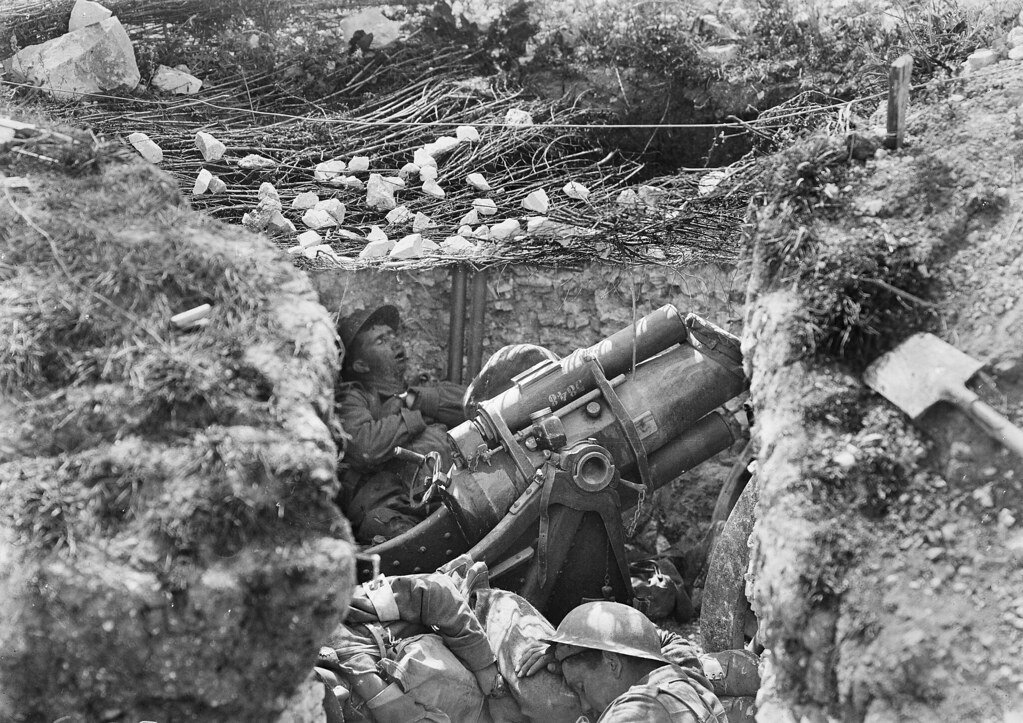
Men of the 15th Battalion, on the day of the fight at Hamel,
worn out and asleep under camouflage which was found
covering a German trench mortar in Pear Trench. (AWM E02664)
The Geddes brothers of the 13th Battalion are a case in point,
and the middle one, Cliff, is right here, right now, soaking up the
music. Originally from Warialda, up Moree way, the brothers Geddes
– 35-year-old Sergeant Aubrey Geddes, 30-year-old Corporal Cliff
Geddes and 24-year-old Sapper Stanley Geddes – had all been bank
clerks before enlisting, and have been in the thick of the heavy fighting
ever since. Aubrey, known as ‘Boo’ to the family, is with B Company
of the 13th Battalion, while Cliff is with D Company of the same, and
Stanley is with Brigadier Pompey Elliott’s 15th Brigade, serving with
the 15th Company Field Engineers.
Like his brothers, Cliff – a distinguished looking fellow, who is neat,
as Diggers go, and careful with his presentation, just as he had been
raised – is dead keen to finish this damn war, and get home as soon as
possible. Like them all, he is proud of Australia’s accomplishments in
these parts, but a little pissed off that so often the Australians seem to be
on their Pat Malone when the heavy lifting is to be done against Fritz.
‘It was a great performance of our Australian lads to drive Fritz out
of this town of Villers Bretonneux,’ Cliff writes in his diary this evening.
‘Lately it seems always a case of the Pommies losing a position, & our
chaps holding Fritz, or having to win back what the Pommies lost.’12
And it is dangerous, make no mistake. A bloke could be killed at any
moment. Oddly, Cliff worries more about his brothers – particularly
Boo even though he is in the same Battalion – than himself, but that is
just the way it is.
‘Haven’t seen Boo since Monday night, trust he’s OK, they are not
getting the shells in the front line we are back here, & if there’s no hop
over, I think he’s pretty right, though one never knows what minute
he’ll be hit at this game.’13
The two key questions that a lot of the Diggers want answered right
now are: firstly, what will the Germans do next?; and secondly, when
will the bloody Yanks dip their bloody oars in?
You see, it seems clear that the Germans are girding their iron loins
for their next attack, which will be a big one, there can be no doubt.
Since Russia pulled out of the war after the Bolsheviks took over late
the previous year, German forces previously on the Eastern Front have
been flooding into France at the rate of 20,000 a week, and as the
Kaiserschlacht showed, Germany is eager to win the war, before the
weight of the Americans, who, in turn, are now flooding into France
at the rate of 60,000 a week, can be felt.
But while the Germans arriving are fighting, the bloody Yanks aren’t
and it is a real problem for those, like the Australians, who are holding
the line.
Typical is the view of the British officer, Captain Hubert Essame of the
8th Division, who had recently fought by the side of the Australians as
they re-took Villers-Bretonneux. His experience has convinced him that
the Australian troops are the best in the war. But great boon that they
are to the exhausted British forces, they will not be remotely enough.
‘A year had now passed since the Americans had entered the war,’
Essame would note, ‘and yet, apart from four good divisions in quiet
sectors on the French front, they had contributed virtually nothing to
the death struggle . . .’
The claim that Amelia Earhart's bones were found on Nikumaroro has been long discredited and exposed as fraudulent; this idea is nothing but more hype and fake news from TIGHAR and their media toadies across the mainstream media. Further, this latest media blitz has surely been coordinated by those in Washington who do not want to see an Earhart memorial on Saipan, and such is their anger that they have activated more than the usual handful of media organizations to spread the latest TIGHAR manure across the land. The timing is too coincidental to be anything else. This new installment of the "lost bones" lie is nothing more than a thinly veiled response to the recent announcement about the plans to build the Saipan Earhart Memorial Monument.
Weasel words like "could have," "likely" and "99 percent probability" season the latest recycled TIGHAR trash, but at the bottom, it's nothing but smoke, mirrors and lies, as usual, from TIGHAR and those in the media who aid and abet their phoney schemes. I ask those who believe in real science -- not discredited fantasies like "remote viewing" -- to study the facts that Earhart researchers have compiled for nearly 60 years, and you cannot come to any other conclusion than Amelia and Fred Noonan's tragic and unnecessary deaths on Saipan.
Murderers are sent to their executions daily on the smallest fraction of the evidence presented in several books since Fred Goerner's 1966 bestseller "The Search for Amelia Earhart" solidly established the presence and deaths of Earhart and Fred Noonan on Saipan following their loss in July 1937, and inspired thousands of Americans to demand action from Congress to reveal the truth, which was thoroughly ignored. The additional mountain of evidence I present in "Amelia Earhart: The Truth at Last" and in my blog, www.EarhartTruth.com to support the Marshalls and Saipan truth brings together Goerner's work and that of several other fine researchers and leaves no other conclusion than Saipan. If TIGHAR had the tiniest molecule of this evidence to support their false claims, the Earhart "mystery," would have been declared "solved" decades ago.
The major problem with the Earhart story is that the American public has been told unceasingly for 80 years that her disappearance is a "great aviation mystery," to the point that this canard has become part of our cultural furniture, blindly accepted without question by nearly everyone. In fact, the U.S. government knows exactly what happened to the fliers and simply refuses to admit it. I will not expand on this basic truth here, however, as anyone unafraid to learn the truth can easily find it. Although the truth about the Earhart disappearance is a sacred cow in Washington, it's also an open secret, available to anyone who desires to find, learn and understand.
Mike Campbell
Jacksonville, Florida www.EarhartTruth.com
"Amelia Earhart: The Truth at Last"